
Amie Maciszewski
About
Dr. Amie Maciszewski is a sitarist who has devoted her adult life to studying, performing, teaching, and promoting North Indian classical music. Amie's training in North Indian music includes both formal academic training in India (Bachelor’s and Master’s degrees with distinction in sitar performance from Santiniketan) and the U.S. (Ph.D. in ethnomusicology) and ongoing traditional study with two leading gurus: Grammy-nominated sarode Maestro Aashish Khan and Hindustani vocal diva Padmabhushan Girija Devi. She has performed in several countries across the globe, to critical acclaim. She is the founder and director of the Sangeet Millennium Ensemble, whose fusion of music from the Indian subcontinent with jazz and other world music has earned its acclaim as one of Austin’s Top Ten world music bands. She is a City of Austin Cultural Contractor and a selected artist on the Texas Commission on the Arts Touring Roster, Mid-America Arts Alliance, and an Empanelled Artist of the India World Cultural Forum. With her Sangeet Millennium initiative, Amie brings Hindustani music to the community and schools as performer and teaching artist, as well as to individuals as a dedicated teacher of sitar and Hindustani vocals to students of all ages. Besides having taught over 100 students individually or in small groupes, she has taught world music and South Asian music on the faculties of the Universities of Texas, Colorado, Pittsburgh, and Alberta, and was awarded special recognition by the University of Alberta's Canadian Centre for Ethnomusicology for her work with their Indian Music Ensemble. In addition to having released four noted CDs, she has co-produced and directed four documentary films on socially marginalized female musicians in India, two of them award-winning.
Teaching Style
I have chosen the lifelong study of the complex and diverse music culture of the Indian subcontinent because of my belief that understanding one culture in depth will facilitate understanding of and appreciation for other cultures. I have been going to India for the past 37 years, where I lived for over a decade to do intensive music study and research. I have been performing and teaching in several countries across the globe for over 25 years.
My goal is to re-present the music and culture of South Asia, in which I have been immersed for more than half of my life, in a manner that is accessible to people of diverse backgrounds, generations, and abilities. I use my grounding in the music and culture of India as a foundation on which to lead students and community members in the exploration of the rich diversity of music and dance in the world, thus raising people’s awareness of and, ideally, their respect for different types of this ultimate human expression. I believe this is an important way to advocate tolerance and, ultimately, world peace.
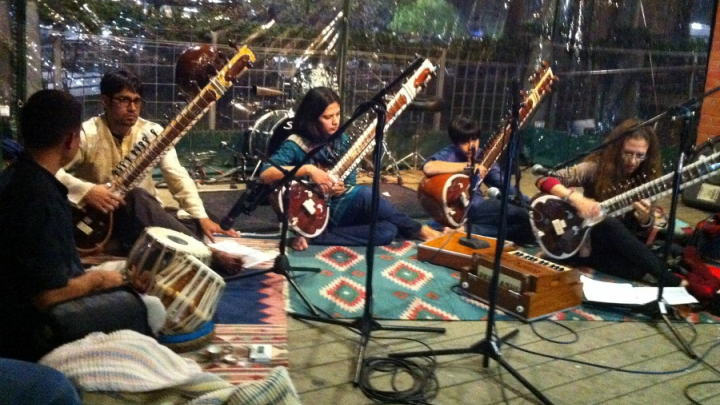
Through teaching music lessons and directing ensembles, I facilitate students of Hindustani music in the discovery of this art form’s formidable challenge, transformative quality, and joyous inspiration. I work to motivate students and nurture their confidence and creativity by providing situations for them to perform together in public contexts. It is my belief that practicing this music and participating in its culture in diaspora will lead students from diverse backgrounds to improve their analytical, problem-solving, critical thinking, and communication skills, as well as broaden their conception of sound, culture, and history.
Thus, my role is that of cultural mediator between music makers of diverse communities, academia, and the public sector. In other words, I advocate an interdisciplinary approach to the study of musics around the world as a study of intercultural communication, understanding, and tolerance.