
Francesco Barone
About
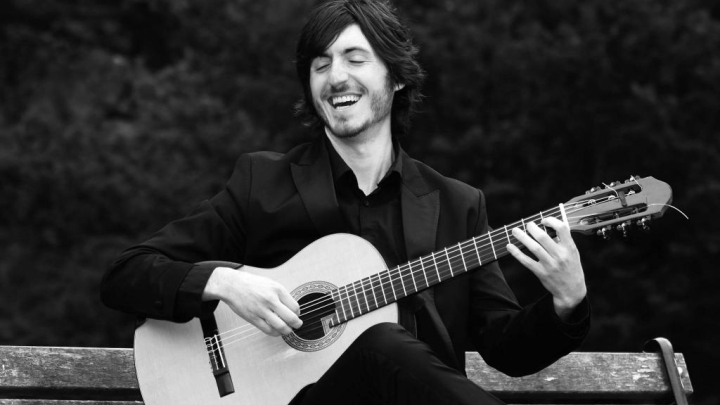
Award-winning guitarist Francesco Barone is celebrated for his "strikingly original programs" and his ability to "play with flair and substance" (Groupmuse).
Barone has graced stages across the United States as both a soloist and chamber musician. He has been prominently featured by esteemed guitar festivals and societies, including the Boston Classical Guitar Society, New England Guitar Society, Connecticut Guitar Society, and The Hartt School Guitar Festival. A prizewinner of the Philadelphia Classical Guitar Society Guitar Competition, his performances have also been broadcast on NPR.
Beyond traditional concert settings, Barone actively engages with local communities, regularly performing outreach concerts at town libraries throughout New England. He connects with younger audiences by performing house concerts nationwide through the classical music startup Groupmuse.
As a dedicated educator, Barone has authored two innovative guitar methods. "Guitar Chords in Context" employs pedagogical sequencing for mastering guitar chords, while "Beginning Classical Guitar" integrates the Suzuki Method, traditional techniques, and the teachings of his late mentor, Richard Provost, into a cohesive approach to classical guitar education. Barone has taught at The Hartt School of Music, Columbia University, and CT State College. He currently serves as a lecturer in guitar and music theory at Saint Anselm College and as the Suzuki Program Director at Wayland School of Music.
Barone holds a Doctorate of Musical Arts and a Master of Music from The Hartt School, University of Hartford. Originally from the Philadelphia area, he earned his Bachelor of Music from Temple University. He performs on a 2018 Alan Chapman guitar.
Teaching Style
As a guitar instructor my primary goal is to instill a love for music in all my students. I achieve this by giving them the ability to communicate their musical ideas while raising their level of playing. In order to achieve this, I equip them with the necessary tools (technique), helping them foster and mature their musical expression (musicianship) and give them an outlet to express themselves (performance).
The study of scales, arpeggios and etudes as well as other exercises addressing various techniques are critical for guitar and music study. However, their function is to help the player execute his or her musical ideas in the most economical and ergonomical way possible. I teach my students techniques as they arise in the repertoire they are studying. For instance, I will prepare a student who will be playing a piece with demanding scale passages by first teaching the scale technique necessary to play that piece. My approach to technique also develops the student’s awareness of releasing excessive tension and to utilize large muscle groups when playing. In time working in this way will cultivate the student’s understanding of technique and mechanical awareness which will allow them to develop an idiosyncratic technique that addresses their own body.
The basis of musicianship is to understand the dynamic and expressive indications on the page of a given score. To deepen this understanding as well as provide a foundation for an informed interpretation, I instruct students to listen to the best quality recordings of the music they are learning. I begin by exposing students to quality guitar recordings and for advanced students expand this to other vocal and instrumental recordings when applicable. I teach students to count and sing their music on letter name while learning pieces. This helps them learn the notes and rhythms as well as facilitates memorization. In time however, the practice of singing and counting will help the student musically mature by developing a vocally conceived vibrato, arriving at interpretations that are rooted in the structure of the music and visualizing the score.
In addition to preparing my students with the technique and musicianship necessary for a successful performance, I address issues such as how to submit program information, properly bow, how to enter and exit the stage and proper attire for performance. Although these items may seem remedial, they are the first to be forgotten amidst the anxiety of a looming performance. I also ensure that my student have many opportunities to perform in order to grow in their comfort and confidence in sharing music with others. In addition to semester recitals, I hold weekly group classes and informal group class recitals (play ins) for my Suzuki students and monthly informal studio classes for my adult students. After these performances I always give positive and encouraging yet constructive feedback to help my students improve and make progress.
My goal is to enrich the lives of my students by helping them express themselves through music. It is my job as a guitar instructor to help them reach their musical goals and professional (or amateur) aspirations by holding them to an excellent standard of technique, musicianship and performance.
Curriculum
For Guitars: https://www.francescobarone.com/guitars.html
For Other Materials: https://www.francescobarone.com/materials.html
Credentials & Affiliations
Education: DMA in Classical Guitar (Hartt School of Music) MM in Classical Guitar (Hartt School of Music BM in Classical Guitar (Temple University) Suzuki Certifications: Guitar Units 1-8, Every Child Can