
Nathan Sonnenfeld
About
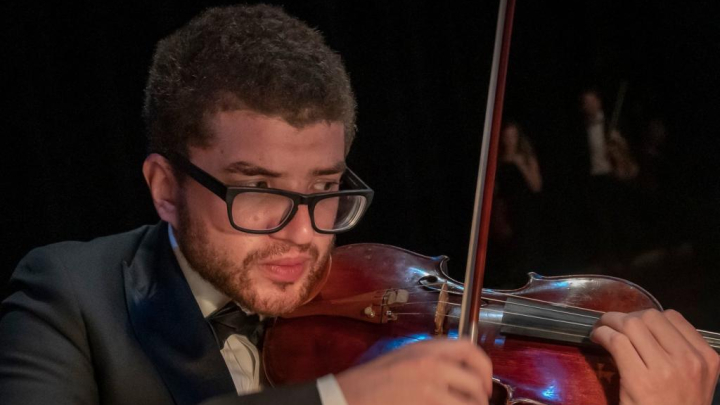
Nathan Sonnenfeld began playing the violin at the age of five. He is currently pursuing his Master of Music in Violin Performance and Suzuki Pedagogy at The Chicago College of Performing Arts at Roosevelt University, where he studies violin with David Taylor. He received his Master of Music in String Pedagogy at the University of Wisconsin-Milwaukee, where he studied violin with Dr. Bernard Zinck and string pedagogy with Darcy Drexler and received his Bachelor of Music from Montclair State University’s John J. Cali School of Music, studying violin with Mary Ann Mumm. Other violin teachers have been Jay Christy, Shannon Thomas, Diane Duraffourg Robinson, Mary Barton, and Joey Corpus. He has played in masterclasses and lessons for Ida Kavafian, Weigang Li, Joseph Silverstein, Joel Smirnoff, and Margaret Karp. With a passion for teaching, Nathan studied Suzuki Pedagogy at the School for Strings under Allen Lieb and has done additional Suzuki studies with Edward Kreitman, Ann Montzka and Linda Case. During the summers, Nathan has participated in the Brevard Music Center, Green Mountain Chamber Music Festival, Miami Music Festival and Eastern Music Festival. An aspiring conductor, Nathan has studied with Dr. Jun Kim, Dr. Shelly Axelson, Dr. Thomas McCauley and Ken Lam.
As an orchestral musician, Nathan has been a member of the New York Repertory Orchestra, Opera Orchestra of Montclair, and the Symphony Orchestras of Montclair State University and University of Wisconsin Milwaukee. He has played under the direction of some of the most prominent conductors in the world, including Gerard Schwarz, Ken Lam, Sebastian Lang Lessing, Rune Bergmann, Mark Gibson, Grant Cooper, Steven Reineke, and Keith Lockhart. He has performed in some of the most prominent concert halls in the world, including Carnegie Hall and David Geffen Hall (formerly Avery Fischer Hall) at Lincoln Center in New York, the Alexander Kasser Theater at Montclair State University, the Adrienne Arsht Center Ziff Ballet Opera House in Miami, Florida and the Cathedral Metropolitina in Buenos Aires, Argentina.
As a teacher, he has taught at Montclair’s Preparatory Center for the Arts assisting with the instruction of the Suzuki Group Classes, worked as an Intern with the New Jersey Symphony Orchestra’s CHAMPS (Character, Achievement and Music Project), was a site administrative assistant for the Paterson Music Project, served on the faculty for the School for Strings Start Up Program and as a strings teacher at Bach to Rock Music School plus maintaining a private studio, teaching private lessons to students of various ages. On the administrative side, he has worked with the New York Philharmonic and Tarisio Auctions.
Nathan plays on a German violin made by Barthol Karner in Mittenwald in 1798.
Teaching Style
As I've studied, practiced and performed, I've come to embrace the term musician in the fullest sense of the word - a skilled player, a knowledgeable student of the art, a teacher and mentor to other musicians and an advocate for the transformative power that music brings to people's lives. Being a musician is practically engrained in me; My great-grandfather was a professional violist who played in the Chicago Symphony Orchestra for 21 years, working under such esteemed conductors like Sir Georg Solti, Clauddio Abbado, and Carlo Maria Guilini. My deep family history of performers forms the backbone of my musicianship and teaching philosophy.
My goal as a teacher is very simple: to not only teach students how to play the violin and acquire the music skills that accompany it, but to foster development in helping that person become highly skilled citizens of society. This core belief has been shaped by the ideas of Dr. Shinichi Suzuki. The origin of Dr. Suzuki’s philosophy develops from an idea he calls the “mother tongue method.” Dr. Suzuki’s idea behind the mother tongue method is that all children were born with the ability to speak their native language, but it is through proper training that they are able to speak the language fluently. Dr. Suzuki, as he explained in his book Nurtured by Love, believes that the method can be applied to all aspects of learning not just specifically music. My hope for all my students is that they will apply some of the skills they learn through music training and apply them to as many aspects of their life as possible. I believe and have seen students take the skills they learn and apply them to other academic, thus improving both their academic grades as well as active classroom participation. For me personally, my love of music led me to reading more about events in history and as such being able to come to conclusions on the intersect between historic events and the arts. (an example that I find particularly interesting is Leonard Bernstein’s connection to the Vietnam War).
It is vital for students to actively be engaged in the learning of the violin: they should show passion and enthusiasm for this craft and the drive to actively continue learning – unlike some traditional school topics, musicians are constantly exploring and expanding their breadth of knowledge. In my lessons, I actively engage students in conversation, asking questions about technique and musical interpretation, helping them in shaping their thoughts and ideas and challenging them to think critically and mindfully. A subjective answer is never a wrong one. I constantly demonstrate through my own playing, giving a visual and aural idea of the topics being presented.
Students come from a variety of different backgrounds and I customize the materials that I use to fit the individual student’s needs. This allows me to find a balance in the students’ individual pace and my own expectations and goals. By doing this, I create an atmosphere that is relaxed and stress free but also focused and engaged. Mimi Zweig stresses the importance of creating a non-judgmental environment, a place where it is ok for a student to make mistakes-mistakes are ok because we learn from them. I strive to create that environment within every lesson I teach. I always push my students to aim for the highest possible level, no matter their ability or career goals. Establishing a genuine mutual respect between teacher and student is an idea I lay out from the very first lesson. It shows the student that I care about them not just in terms of their development as musician but as a person as well. I am very vocal about them having access to me as a resource, even non-music related.
It is very important to me that the student understands how their bodies are constructed physically – this allows them to gain a grasp of how to fit and conform the violin to their own body, rather than conforming the body to the violin. This is done through constant experimentation of shoulder rests and chinrests. We also experiment with different left- and right-hand positions in relation to holding the violin and bow, in an open discussion. As I have discovered, there is no one size fits all when it comes to the physical technical aspects of violin playing and I make sure that students understand that early on.
From the very start, I make sure to instill a solid technical foundation within all my students. This is done through a carefully prepared diet of scales and etudes. For example, a young student working from Suzuki Book 3 will also study Suzuki’s position etudes and quint etudes as well as appropriate scales and arpeggios plus sight reading and note reading skills. Scales and Etudes also allow me to specifically target technical weaknesses and give students a vehicle to practice those techniques in detail. I use this approach with my beginning students all the way up to collegiate musicians. Repertoire choices are made based on the ability of the student, but I take extra care to listen to suggestions from the student and actively work with them to create a proper repertoire sequence plan that gives students proper technical and musical skills, but also makes the learning process enjoyable for the student. It is important to me that a student looks forward to a lesson and coming to play for me.
The idea of musical expression and interpretation is also stressed heavily. Often, I will express to students that technique should be used in service of the music and to not let technique interfere with musical expression. I also create weekly listening assignments for my students, based on the repertoire they are learning. For example, if a student is learning Mozart’s 5th violin concerto, I would ask that they listen to other genres that Mozart wrote in, namely the symphonies, piano concertos and operas. Finally, I encourage students to actively explore other musical genres, especially Jazz, Rock & Roll, Pop, and even Hip-Hop and Rap. By doing this they are broadening and expanding their musical minds and showing them that making challenging creative decisions occurs in not just classical but all music and art forms.
The journey of a musician is a complicated one. The lows are devastating and the highs euphoric. Once the commitment to becoming a fully realized musician becomes a part of your being, you recognize there is no other option. My job as a teacher is to assist and guide students as they embark on their musical journeys.
Curriculum
My teaching techniques are highly influenced by Shinichi Suzuki, Ivan Galamian, Josef Gingold, Tadeusz Wronski and Dorothy DeLay. I am also heavily influenced by the general music techniques of Leonard Bernstein as well.
Suzuki Violin School Books 1-8
Suzuki Quint Etudes
Suzuki Position Etudes
Barber Scales for Young Violinists/Scales for Advanced Violinists
Flesch Basic Studies
Schradieck The School of Violin Technics
Sevcik School of Violin Technics, Op. 1
Flesch Scale System
Etudes by Kayser, Kreutzer, Dont and Rode
Credentials & Affiliations
Bachelor of Music - Montclair State University,
Master of Music - University of Wisconsin-Milwaukee,
Master of Music - Roosevelt University,
Suzuki Teacher Training - School for Strings,
American String Teacher's Association,
Suzuki Association of the Americas,
Music Teachers National Association,