
Takis Barbas
About
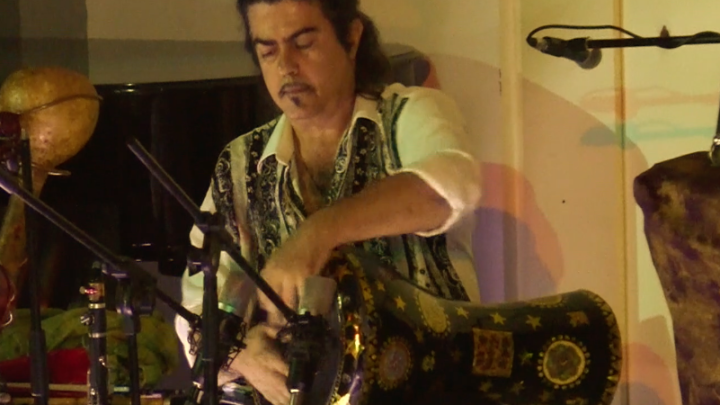
Takis Barbas was born in Ioannina, Greece. From a very early age his main need was to live by the sounds of music and percussion instruments of every kind. This urge led him to start searching for his first teachers. In 1980, Takis started his professional career by playing Greek traditional folk music at night clubs as a full time job.
In 1984, influenced by international music genres, Takis moved to Paris, where he focused on music styles new to him, like Latin, Jazz, Big Band, Reggae, Afro etc. He started an intensive course of studies at the College of Rhythm and Percussion "Dante Agostini" and he performed with musicians from Armenia, Turkey and the Arab countries, this enriching his relationship with music from both the East and the West. In the meantime, he taught Greek music.
Takis obtained the teaching diploma C.E.S.M.A. in 1990 and the first prize for performance and virtuosity with his unique personal style. This allowed him to create the first department of the homonymous school in Greece.
The next stop of his research was India from 1996 to 1997. Takis lived for one year in Benares, studying tabla, bansuri, cimbalom and phonetics at the Banaras Hindu University. There he broadened his musical horizons and studied the common features of Indian and Greek music.
Teaching Style
In 1991, Takis founded the Greek department of the music school "Dante Agostini" in Thessaloniki, one of the thirty-three in Europe. Students of every age and level have studied there. Many of them started as famous performers or professors and others as beginners that now are sought after in the field of both education and performance. Since teaching was always a part of him, in and out of Greece, the number of his students has risen to 1500.
Curriculum
His thirty-year experience in education led to the creation of the four-volume method "Labyrhythm" in 2004, after a request from the University of Macedonia. This book aimed at the establishment of Greek rhythms in comparison with international music genres as an academical course. That helped entrench the traditional percussion instruments in higher education through a four-year study program. The subject of rhythm education was also added in the academical program for every music student regardless of genre and instrument.
This system broadens the understanding, the memory, the composition and the improvisation on effective oriental and oxidental forms, which are necessary in order for anyone to express themselves with clarity in any kind of music and helpfully as an easy structure teaching mentality. The key is to delve into the transmission of the exact feeling of every rhythm to the musician himself as well as to the audience.