
Felicia Behm
About
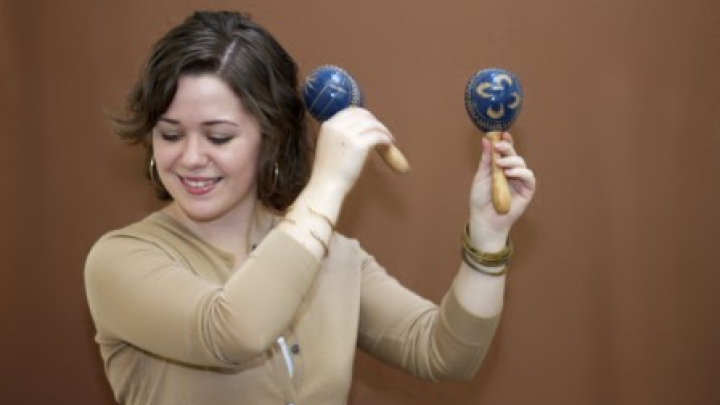
Felicia Behm is an innovative educator and percussionist based in the Denver-metro area. She teaches elementary band as well as private percussion, piano, and flute lessons. She performs across the front range and provides clinics to student groups throughout the year.
Felicia received her Bachelor of Music in Music Education in 2009 from Lawrence University. While there she studied classical percussion, West African drum and dance, Afro-Cuban and Brazilian drumming with Dane Richeson, and Balinese gamelan with Sonja Downing and I Dewa Ketut Alit Adnyana. She also studied conducting with Andrew Mast and education with Laura Sindberg, Carol Lenz, and Craig Gall.
She has performed with a variety of ensembles, including the Colorado Wind Ensemble, Mudra Dance Studio, Wyoming Symphony, Gamelan Tunas Mekar, and the Lakewood Symphony. Felicia has also participated in the International Body Music Festival with Keith Terry and co-founded Lawrence University’s first body music ensemble with Stacey Stoltz (LU ’11).
Felicia served as a clinician for the Fox Valley Youth Symphony and as an instructor for the Lawrence Academy of Music. She completed her student teaching in Kimberly, WI, taught English in Madrid, Spain, and was the band director at Lincoln High School in Lincoln, CA. Currently she teaches private lessons and beginning band in South Denver. She began Slap Happy Music Studio, a music school based on a holistic and exploratory approach to music education, in 2011 and was both owner and instructor there until 2015.
As a percussionist, Felicia has worked with many artists, including Michael Spiro, Nancy Zeltsman, Nani Agbeli, Keith Terry, Joe Locke, Jackeline Rago, Michael Burritt, Gordon Stout, I Made Lasmawan, Mestre Galego and Mestre Acordeon.
Felicia endorses Vic Firth and bdlpercussion.
Teaching Style
I love to teach. I love the lightbulb that goes off when a student learns something new…the “click” that happens when suddenly your body does what you’ve been telling it to do…the vicarious thrill that I get every time a student has their first performance. As a teacher, I get to experience my first band concert, my first piano recital, my college auditions, my summer music programs, and my lessons with favorite teachers (the fun, the horrible, and everything in between) over and over again. I get to play games, make jokes, discover new music, stumble across old favorites, and explore new techniques every day. Is it easy? Not always. Is it worth it? Absolutely.
I run my lessons a little differently based on the age of the student:
--For elementary children, I typically divide the lesson into 3 parts: technique, theory, and performance. We will learn note-reading through exercises and games, practice fundamental techniques such as posture, and focus on one song per week. That one performance song usually has a particular goal, whether it is to play with correct rhythm, with dynamic contrast, or simply to play a fun song for the week (very common around holidays).
--For adults, on the other hand, the lesson is up to you. I always have a particular goal I'd like to accomplish, but your particular interests are why we're here. If you want to play pop songs on the piano, great! But we'll probably still do some scales for technique building. Want to play four-mallet marimba, great! But we'll probably still do some basic two-mallet exercises to focus on reading or rhythm.
--High school and advanced middle school students tend to be a blend of the above two lesson approaches. I divide the lesson more in half: half for me (theory, technique, sight reading) and half for you (do you have a particular song you want to learn? This is where that happens). You know what you want, but I still want to be sure you are getting the fundamentals to help you achieve your goals. The more advanced you become, the more power you have to direct the lesson.
Music theory lessons, however, are a lot more structured. We have to go in order, but you still get to have some say in whywe are studying theory. I will teach you the way music theory works, as well as computer notation software if you are interested in that, but the end goal is yours. Do you want to compose your own music? We can do that. Do you just want to improve your performance by understanding the theory? Sounds good to me. And are you trying to pass an AP music theory or college entrance exam? We'll focus the lessons on doing just that.
Music should be fun. If you're not learning what you want, I'm doing something wrong. Be specific with what goals you want to achieve and I'll help you get there.