
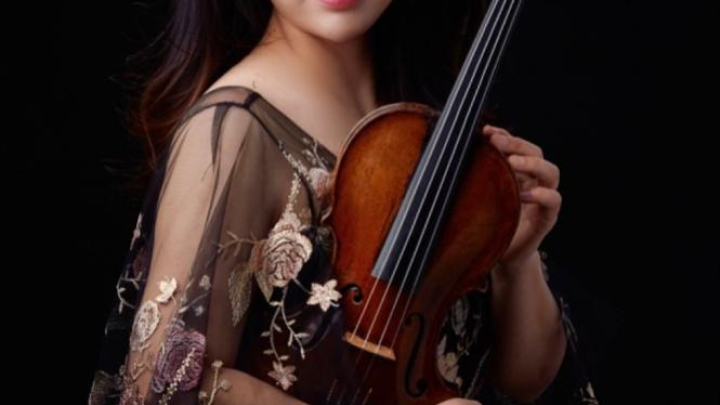
Stella Choi
About
Education
University of Illinois – Urbana Champaign
Degree pursuing: Doctor of Musical Arts
Major Field of Study: Violin Performance and Literature
University of Michigan – Ann Arbor
Degree Awarded: Master of Music (1)
Major Field of Study: Violin Performance
University of Michigan – Ann Arbor
Degree Awarded: Master of Music (2)
Major Field of Study: Chamber Music
University of Colorado at Boulder
Degree Awarded: Bachelor of Music
Major Field of Study: Violin Performance
Awards and Achievements
Teaching Assistantship – University of Illinois
Summer Fellowship – University of Illinois – School of Music
Tuition Waiver Merit Scholarship – University of Illinois School of Music
Collage Concert Chamber Music Award – Selected to play as a piano quintet, University of Michigan
Adopt-A-Student Award – University of Colorado
Takcas Quartet Award – University of Colorado
Private Sponsorship Award – University of Wisconsin
Wisconsin State Honors Orchestra Award
Young Artist Concerto Competition, Honorable Mention – Milwaukee Symphony Orchestra
Masterclasses
Erin Schreiber (2022) – Associate concertmaster of Saint Louis Symphony.
Sarita Kwok (2022) – Professor at Gordon College
Glenn Dicterow (2022) – USC Thornton School of Music, Manhattan School of Music Andreas Cardenes (2022) – Former concertmaster of Pittsburgh Symphony.
Pierre Amoyal (2022) – Mozarteum Conservatory
Mikhail Kopelman (2014) – Eastman School of Music
Payvit Meller (2014) – Sibelius Academy
Josef Kalichstein (2012) – The Juilliard School
Kurt Sassmanshaus (2011) – University of Cincinnati
Ani Kavafian (2008) – Yale University
Teaching Style
My teaching philosophy is based on that learning music and instruments should be as natural as possible, in a way that resembles much of the developmental process of linguistic competence in human beings. Today’s pedagogical notion of classical instruments still extensively – if not only - suggests following the ‘traditional old-school method’ in order for the students to be established with solid basic techniques. Such notion is especially emphasized during early stages of learning for younger students, and I believe that it has been putting brakes on further developments of string pedagogy for adult students. I see that there are big demands for more guidelines and suggestions, for both teachers and students of any level, on how to spontaneously adopt and modify the materials based on the needs and differences of each individual. Therefore, I believe that it is extremely crucial for instructors to be focusing on diagnosing each student’s personality and characteristics with great accuracy. The instructor should also be able to take full responsibility for assigning suitable materials for the students to maximize the efficiency in their learning process.
Having extensive amounts of experience in teaching both violin and foreign language, I have realized that there are many common aspects between learning musical instruments and foreign language. The two most significant similarities are 1) the best outcomes come from the ground base of natural yet organized building process in learning, and 2) careful studies on different possibilities and variables of each student is a must-have for success. I consider music is another form of human language. The learning process needs to be natural and nurturing, structured, and must be guided by a teacher who can provide spontaneous solutions in any possibilities. My experience as both a teacher and a performer has given me numerous opportunities to expand my insight as an educator. In addition to developing different perspectives in teaching violin, construct my unique ways of teaching especially for the students with unexpected circumstances and issues, and most of all, being able to have keen ears as a teacher enabled me to diagnose immediately of each student’s issues both technically and musically
Despite the abundant amounts of resources available in studying musical instruments today, it is unfortunate to see the common belief of ‘majoring in musical instruments needs something “special”’ still exists. The debut ages to big competitions are becoming younger each year, and major conservatories who take them as their students often get prioritized to be spotlighted. Public fundings for performing arts seems to be still very limited in the US, and people give up on music because of not enough talent, money, or being over the “age limit”. In this sense, classical music field may be the most difficult for the idea of equity and inclusion to break into. In my opinion, this situation will not change without some significant developments in teaching adult students who are intermediate to college level. Instead of considering that teaching adult instrumentalists is just continuations and repetitions of their earlier trainings, more innovative learning methods should be developed for them. To me, equity and inclusion in teaching music means providing more opportunities for anyone of any age from any circumstances. I sincerely believe that the role of non-conservatory institutions is extremely crucial in order to achieve this. These institutions should be the places where students who are still in the process
of developing could find their ways to grow before going into the professional world with confidence and security. I could not be more positive that I have so much passion and determination to help those students to achieve their goals as musicians. I want to show my students that there should be neither barrier nor impossibility when it comes to learning a musical instrument. I would like for my teaching to be an enlightenment to all of my students and help them to realize that their future dream as professional musicians could be achieved in any stage of their lives if approached efficiently and effectively.
Teaching is my passion. It is the greatest joy to see my students improve every lesson. Nothing is ever more rewarding for me than listening to the sound of my students, feeling along what they are trying to say through music, discussing their current technical obstacles, and finding the best solutions for them. I believe I possess the requirement to fulfill this position. I look forward to my ability as an innovative educator and continue to grow as a mentor for my students.