







Find Your Ideal Opera Teacher for Lessons Online
For beginners to advanced, kids & adults, these excellent Opera teachers are vetted by staff experts and reviewed by verified students of online lessons at Lessonface.
View All Teachers Related Topics
Discover experienced, passionate Opera teachers to help you reach your next level.
100+
Vetted Teachers
5.0
Average Rating
40+
Student Ratings
~$41
Avg. Lesson Price
View All Teachers

New to Lessonface
Margherita Rotondi
🎵 Opera Singing Lessons with Margherita Rotondi Mezzo-soprano born in Bari, Margherita Rotondi graduated with highest honors from the Conservatorio di Bari and earned her Master’s Degree in Baroque Singing with 110 cum laude and special mention from the Conservatorio di Ferrara.
$30.00 / 30 min

1 Year on Lessonface
Guille Sarquis
I am a musician, composer, and classically trained singer. I graduated from the National University of Córdoba with a degree in Music Education (2011). I am also a Magister and Supervisor of the Benenzon Model of Non-Verbal Therapy (2012).
$25.00 / 60 min

2 Years on Lessonface
Francesca Pusceddu
Ciao! My name is Francesca Pusceddu and I was born in Sardinia (Italy). I am an opera singer, graduated in singing Summa cum Laude and trained at the Dutch National Opera Academy of Amsterdam. I perform internationally both Opera and Oratorio. I am also a music teacher, I follow many singers in several different styles. I teach since more than 10 years and I enjoy it deeply.
$40.00 / 30 min

9 Years on Lessonface
Denise Bayraktar Sharp
I hold a Master's in Voice Performance degree from University of New Orleans and Bachelor of Science degree in Voice Performance from State Music Academy, Sofia, Bulgaria. In 2001, I toured with International European Opera Company which performed numerous times in Denmark, France, Italy and USA.
$35.00 / 30 min
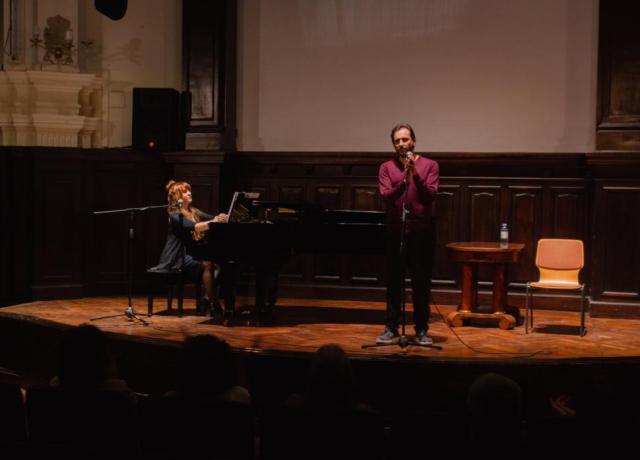
Photo: Guille Sarquis
Guille is wonderful at providing direction in his lessons, there is no wasted time and every exercise is very productive. You can tell that he cares about you as a student and your progress. I've felt like my technique has improved substantially in my lessons with him as well as my confidence :). Of all the vocal teachers I've had, I've seen the most improvement, the quickest, with Guille!

Want help finding your ideal opera teacher?
Fill out the quick form and teachers who fit your needs will be in touch.

Photo: Peter Furlong


Great Opera Teachers
Through our longstanding commitment to treat teachers equitably, we work with phenomenal instructors — including members of the MET Orchestra, Juilliard and Berklee alumni, GRAMMY® winners and nominees, and many other professional educators.
View Teachers Photo: Guille Sarquis
About Opera Lessons at Lessonface
Find a great teacher, securely book a first lesson or trial, and meet via Zoom. Lessonface handles the lesson links and sends you reminders. Recordings, assignments, and notes are easy to access before, during, and after the lesson.
View Teachers 











Latest from the Blog
Tips, stories, and interviews from the Opera community.

Lessonface Guarantee
Reach out to tell us within 48-hours of taking an unsatisfactory lesson, class, or course, and we will offer you a refund. Read more about the guarantee.

Designed for All Ages
Creating a joyful, safe, and convenient educational experience for our students is our goal. Learn more about our kid-friendly features here, or read our privacy policy and safety precautions here.
Have more questions? Check out our FAQ, or reach out.
About Lessonface
At Lessonface, we've held our mission of helping students achieve their goals while treating teachers equitably for over ten years. We're here to help you connect to your ideal teacher and make real progress. Please reach out with any questions or concerns.
 Claire Cunningham
- Founder & CEO
What is Lessonface?
Lessonface is a Public Benefit Corporation operating since 2012 whose purpose is to connect students with great teachers for music, language, and arts lessons. Teachers on Lessonface set their own rates and profiles, and students can select their ideal teachers based on their background, teaching style, rates, and schedule.
How do online Opera lessons work?
Online lessons are effective, affordable, and accessible. Lessonface qualifies teachers in over 300 music, language, and arts subjects, including Opera. Students can browse teachers' profiles, send them messages, and book lessons securely through Lessonface. Lessons happen via Zoom links that are securely generated for each lesson, and can be easily recorded by the teacher. Recordings, notes, and attachments can all be accessed from within the Lessonface dashboard. Lessons can be booked one at a time, in packages, or by subscription to save a spot on the teacher's calendar. Lessonface hosts recitals, open mics, group classes, and self-paced courses too. Registering an account is free so it's easy to get started reaching out to find your ideal instructor. Contact us with any further questions!
What is the best method for learning Opera ?
We're biased, of course, but at Lessonface we believe the best way to learn Opera is through one-on-one lessons. Personalized instruction means your teacher can tailor every lesson to your goals, learning style, and skill level. Online group classes can also be a great way to make learning fun and social. Learning Opera online makes it easy to stay consistent, which is essential to steady progress.
There are plenty of apps and YouTube videos out there to help with learning Opera, but most teachers agree that those resources work best as supplements to, not replacements for, one-on-one instruction. A skilled Opera teacher can identify bad habits before they become ingrained, help you focus on what matters most, and solve problems as soon as they arise, often saving you months of frustration and wasted practice time. The bottom line? A real teacher accelerates your progress and keeps you on the right path from day one.
How do I find the best teacher for me for Opera lessons?
With over 100 qualified Opera teachers who have together earned an average of 5 out of 5 stars over 42 lesson reviews by verified students, you can be sure to find a great instructor at Lessonface.
Lessonface offers free tools to help you find the ideal tutor for you or your family:
- Use the open filtering system
- Use our matching service to describe your background, scheduling preferences, and any particular goals, and qualified Opera teachers will respond.
You can view teachers' bios, accolades, rates, send them a message and book lessons from their profiles.
Many teachers offer a free trial, and you can book lessons one at a time until you decide you prefer to book a bundle or subscribe, so don't hesitate to try. Teachers may also offer group classes, self-paced courses, and downloadable content, so there are more ways to get started while you're still getting acquainted with the community.
How much do Opera lessons cost?
Opera teachers on Lessonface set their own rates. Rates are displayed on the teachers' profile pages and in the checkout process prior to booking. Teachers may choose to change their rates for new bookings, and students will always be notified prior to making payment. The average paid for a Opera lesson on Lessonface in the past 12 months was $32.06. Some Opera teachers offer a free trial lesson to new students, which are not factored into the average prices.
How does payment work for Opera lessons?
There is no fee until you book your first paid lesson. Many teachers offer free trial lessons. Students can opt to book one a time, or purchase lesson packages or subscriptions for scheduling convenience, and, depending on the teachers, a discount. Payment can be made by credit card or Paypal. Lessons booked with a subscription are pre-paid three days before the end of the month for lessons that are scheduled for the following month. Subscription payments can only be made by credit card (not Paypal). Teachers receive their payment after the lesson has been completed.
What are the major voice types in opera?
Opera has a highly developed system for categorizing voices, and understanding where your voice fits is one of the first things a serious opera student works out with their teacher. The major voice types — called Fach in the German tradition — divide voices first by gender and register, then by weight, color, and range.
Female voice types:
- Soprano: the highest female voice, carrying many of opera's most iconic roles — from Mozart's Queen of the Night to Puccini's Mimi and Tosca. Subdivisions include lyric soprano, dramatic soprano, and coloratura soprano, each suited to different repertoire.
- Mezzo-soprano: a richer, darker tone in the middle range. Mezzo roles range from trouser roles in Mozart to the great Verdi and Bizet parts.
- Contralto: the deepest female voice — warm, dark, and relatively rare. True contraltos occupy a specific and distinctive place in the repertoire.
Male voice types:
- Tenor: the highest common male voice and one of the most celebrated in opera. Many of the most prominent male roles are written for tenor.
- Baritone: a middle-range voice with a warm, full quality. Baritones sing some of opera's most dramatically rich and complex roles.
- Bass: the lowest male voice, often cast as authority figures, villains, or comic characters. Between these categories sit the bass-baritone and the Heldentenor — a powerful dramatic tenor associated with Wagner.
Voice type isn't always immediately obvious, and it can shift as the voice matures. A good teacher will help you identify yours without rushing the process.
How do opera singers project without a microphone?
This is one of the most remarkable things about operatic singing — and one of the things that makes it genuinely unlike any other vocal style. A trained opera singer can fill a 3,000-seat house with unamplified voice over a full orchestra. That's not a matter of simply singing louder. It's the result of years of specialized technique that fundamentally changes how the voice produces and projects sound.
The key is resonance. Opera singers learn to direct their sound into the resonating spaces of the body — the chest, the pharynx, the sinuses, the skull — in a way that amplifies and focuses the voice naturally. This produces a carrying power that a microphone actually can't fully replicate, because it's not just volume — it's a quality of sound that cuts through and projects in a large acoustic space.
A specific phenomenon called the singer's formant is central to this. The singer's formant is a concentration of acoustic energy in a frequency range around 2,000 to 3,000 Hz — a range where the orchestra is relatively quiet. By producing strong energy in this frequency range, opera singers essentially carve out a space in the sonic spectrum where their voice can be heard clearly above the orchestra without competing with it directly.
Breath support is the other half of the equation. The kind of sustained, controlled airflow that operatic projection requires demands a level of breath management that takes years to develop fully. The diaphragm, the intercostal muscles, and the whole respiratory system work together to produce a steady, powerful column of air that drives the resonance.
This is why opera training takes as long as it does — these physical skills can't be rushed.
What is vibrato, and how do opera singers develop it?
Vibrato is the natural, slight oscillation in pitch that gives a sustained vocal note its warmth, richness, and sense of life. It's one of the most immediately recognizable qualities of the operatic voice, and one of the most misunderstood.
The key word is natural. Healthy vibrato isn't something a singer manually adds to a note — it's the result of a well-supported, freely produced voice. When the breath is properly engaged, the vocal cords are free from unnecessary tension, and the resonance is well-placed, vibrato tends to emerge on its own as a byproduct of good technique. This is why experienced teachers often say you don't develop vibrato directly — you develop the conditions that allow it to happen.
That said, vibrato can be shaped, controlled, and refined. Opera singers learn to adjust the speed and width of their vibrato for different repertoire and expressive purposes — a wider, slower vibrato might suit a dramatic Verdi role, while a lighter, faster vibrato might be appropriate for Baroque music. Learning to use vibrato expressively and intentionally, rather than just letting it run on autopilot, is part of advanced vocal development.
Vibrato problems — too wide, too fast, too slow, or absent entirely — are often symptoms of underlying technical issues rather than problems with the vibrato itself. A voice that trembles uncontrollably usually has a breath support problem. A voice that sounds straight and inflexible may be carrying too much tension. A good teacher addresses the root cause rather than trying to fix the vibrato directly.
For beginners, the most productive approach is simply to focus on building healthy technique and trust that vibrato will develop as a natural result.
What languages do opera singers need to learn?
The core operatic repertoire is concentrated in four languages — Italian, German, French, and English — and most serious opera students develop some working knowledge of all of them over time. That doesn't mean fluency in all four; it means learning to pronounce them correctly, understand what you're singing, and deliver the text with meaning and clarity.
Italian is the starting point for almost every opera student, and for good reason. The majority of the core repertoire — Verdi, Puccini, Rossini, Donizetti, Bellini — is in Italian, and the language's open vowels and clear consonants make it particularly well-suited to singing. Italian diction is often the first foreign language an opera student studies.
German is essential for anyone interested in Mozart's German operas, Wagner, Strauss, and the broader Germanic repertoire. German diction is more complex than Italian — the consonant clusters and umlauts require careful study — but it's indispensable for a significant portion of the repertoire.
French opens up the worlds of Bizet, Gounod, Massenet, Debussy, and the entire French operatic tradition. French diction has its own particular challenges — nasal vowels, liaison rules, and a very specific relationship between text and musical phrasing.
English-language opera — Britten, Handel's later works, American opera — is a growing and important part of the repertoire. Singing expressively in your own language presents its own challenges, particularly around natural-sounding diction.
Beyond these four, Russian, Czech, and Spanish repertoire may become relevant depending on a singer's Fach and career interests. A good opera teacher will introduce diction study as an integral part of vocal training from early on.
I have some classical vocal training. How do I know if I'm ready for opera repertoire?
This is exactly the kind of question to work through with a teacher — because "ready for opera repertoire" means different things depending on what repertoire you're talking about and where your voice currently is.
The range of operatic repertoire is enormous. Some of it is genuinely accessible to intermediate singers with solid classical training. Some of it makes demands that even experienced professionals approach carefully. Knowing which is which — and which pieces are right for your specific voice at this specific moment — is one of the most valuable things a knowledgeable teacher brings to the table.
That said, there are some general markers worth thinking about. On the technical side, you're probably ready to start exploring opera repertoire when your breath support is reliable enough to sustain long phrases without forcing, when your tone is consistent across your range without significant breaks or weak spots, and when your vowels are well-formed and your diction is clean. These are foundational skills that opera repertoire will test and develop further — but you need a working version of them before the music will serve you rather than strain you.
On the musical side, some comfort with foreign language diction — particularly Italian — and the ability to learn music from a score rather than by ear are both practically important for most opera study.
The more important question isn't whether you're ready for opera in the abstract — it's whether you're ready for a specific piece. A teacher who knows your voice can identify repertoire that will challenge and develop you appropriately, and steer you away from music that could push your voice in directions it isn't ready for yet.
Starting with the right repertoire makes all the difference.
What is the difference between opera, operetta, and musical theater?
These three forms exist on a continuum, and the lines between them have always been blurry — but understanding the distinctions helps make sense of the repertoire and the vocal demands of each.
Opera is the oldest and most formally demanding of the three. It's a through-composed dramatic work in which virtually all of the text is sung — there is little or no spoken dialogue. The vocal demands are the most rigorous: opera singers project without amplification over a full orchestra in large houses, and the technique required to do that takes years of dedicated training to develop. The repertoire draws primarily from the European classical tradition, and the musical language tends to be complex and compositionally sophisticated.
Operetta emerged in the mid-nineteenth century as a lighter, more accessible form. Think Gilbert and Sullivan, Johann Strauss II, and Lehár. Operetta mixes sung numbers with spoken dialogue and tends toward comic plots, tuneful melodies, and a generally lighter vocal weight than grand opera. It was enormously popular in its time and is widely seen as a direct ancestor of musical theater.
Musical theater grew out of operetta traditions and American popular music in the early twentieth century. It incorporates singing, spoken dialogue, acting, and dance into a unified dramatic form. The vocal style is more diverse — from the belting and mix techniques of Broadway to the more classical demands of certain shows — and amplification is standard. The relationship between text, character, and song is central in a way that distinguishes it from opera's more music-driven aesthetic.
In practice, some works sit right on the borders — and some singers move fluidly between all three worlds.
What is bel canto, and why does it matter for opera singers?
Bel canto — Italian for "beautiful singing" — refers to a style of operatic singing that flourished in the late eighteenth and early nineteenth centuries, associated with composers like Rossini, Donizetti, and Bellini. But it means something more than just a historical style. In contemporary vocal pedagogy, bel canto has become a foundational approach to training the voice that informs how many teachers work with singers across all repertoire.
The bel canto ideal emphasizes a free, naturally produced tone — smooth, even, and resonant across the full range of the voice. It prizes legato singing, where notes connect seamlessly without interruption, and agility — the ability to move through rapid passages, ornaments, and wide interval leaps with ease and precision. The voice is never forced or pushed; the goal is always beauty of tone and technical mastery in service of musical expression.
Why does it matter today? Because the physical principles behind bel canto technique — proper breath support, free resonance, even register transitions, and flexible agility — are the same principles that underpin healthy, sustainable singing in virtually any style. Many opera teachers use bel canto repertoire as a training ground precisely because it develops these fundamentals so directly.
For opera students, bel canto repertoire — the great arias of Donizetti and Bellini in particular — is some of the most technically demanding music ever written for the voice. Learning to sing it well develops capabilities that carry over into heavier dramatic repertoire later on.