





Find Your Ideal Native American Flute Teacher for Lessons Online
For beginners to advanced, kids & adults, these excellent Native American Flute teachers are vetted by staff experts and reviewed by verified students of online lessons at Lessonface.
View All Teachers Related Topics
Discover experienced, passionate Native American Flute teachers to help you reach your next level.

3 Years on Lessonface
Aneesh Kashalikar
I'm a woodwind player specializing in many reed instruments and flutes. I play saxophone, clarinet, duduk, aulos, pivana, hichirki, xiao, and several other instruments. I have studied from some of the best instrumentalists in these instruments and would be happy to share my knowledge to people interesting in learning the instruments I play.
$15.00 / 30 min

7 Years on Lessonface
Ami Sarasvati
Native American Style Flute Teacher *2020-2025* Teacher of the Year for Native American Style Flute* About the Native American Style Flute Instruction If you have ever wanted to learn an instrument but never found the time… If you have owned a Native American style flute but haven’t played it yet… If you think that you are not musical and have no musical ability… You are in for a…
$50.00 / 30 min

2 Years on Lessonface
Agafiia Gurko
Education I began my music education at the Gnessin Music School in Moscow (2004–2015) and later studied at the Academic Music College at the Moscow State Tchaikovsky Conservatory (2015–2019), where I graduated as a state-certified music teacher with flute as my main subject.
$25.00 / 30 min
6 Years on Lessonface
David Antonio
I've been playing the guitar for over 40 years and have experience in teaching school age students as well as adults. In addition to this I play and teach Native American Style Flute and Didgeridoo. I also have experience working with those with special needs. Over time I have learned various styles and techniques for guitar, it is my main instrument.
$20.00 / 30 min
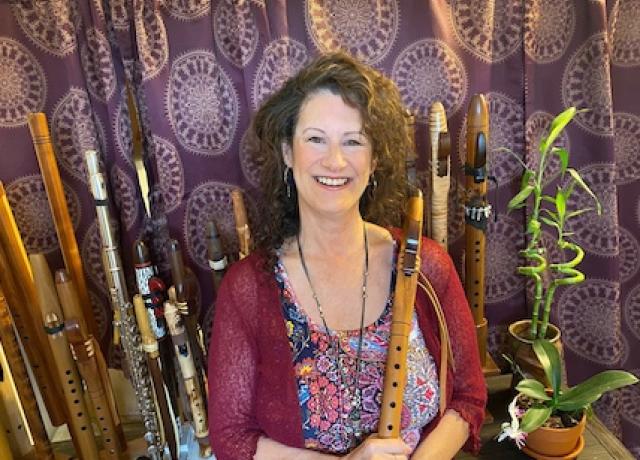
Photo: Ami Sarasvati
Ami is so encouraging and supportive. Ami also is able to balance the right amount of information and techniques without overloading - which means that my ability to absorb the teaching is always kept within reach. I love the perspective she comes from which includes so much space to explore the instrument and grow the relationship with it and the music. : ) I am having the best time learning - feel so uplifted after a lesson and it continues through the week. I have no idea where I am going - but, boy, I am really enjoying the journey.....

Want help finding your ideal native american flute teacher?
Fill out the quick form and teachers who fit your needs will be in touch.
Photo: Ami Sarasvati


Great Native American Flute Teachers
Through our longstanding commitment to treat teachers equitably, we work with phenomenal instructors — including members of the MET Orchestra, Juilliard and Berklee alumni, GRAMMY® winners and nominees, and many other professional educators.
View Teachers 
Photo: Michele Denise Michaels
About Native American Flute Lessons at Lessonface
Find a great teacher, securely book a first lesson or trial, and meet via Zoom. Lessonface handles the lesson links and sends you reminders. Recordings, assignments, and notes are easy to access before, during, and after the lesson.
View Teachers 











Latest from the Blog
Tips, stories, and interviews from the Native American Flute community.

Meet 2025 Teacher of the Year for Native American Flute Ami Sarasvati
Read more
Lessonface Guarantee
Reach out to tell us within 48-hours of taking an unsatisfactory lesson, class, or course, and we will offer you a refund. Read more about the guarantee.

Designed for All Ages
Creating a joyful, safe, and convenient educational experience for our students is our goal. Learn more about our kid-friendly features here, or read our privacy policy and safety precautions here.
Have more questions? Check out our FAQ, or reach out.
About Lessonface
At Lessonface, we've held our mission of helping students achieve their goals while treating teachers equitably for over ten years. We're here to help you connect to your ideal teacher and make real progress. Please reach out with any questions or concerns.
 Claire Cunningham
- Founder & CEO
What is Lessonface?
Lessonface is a Public Benefit Corporation operating since 2012 whose purpose is to connect students with great teachers for music, language, and arts lessons. Teachers on Lessonface set their own rates and profiles, and students can select their ideal teachers based on their background, teaching style, rates, and schedule.
How do online Native American Flute lessons work?
Online lessons are effective, affordable, and accessible. Lessonface qualifies teachers in over 300 music, language, and arts subjects, including Native American Flute. Students can browse teachers' profiles, send them messages, and book lessons securely through Lessonface. Lessons happen via Zoom links that are securely generated for each lesson, and can be easily recorded by the teacher. Recordings, notes, and attachments can all be accessed from within the Lessonface dashboard. Lessons can be booked one at a time, in packages, or by subscription to save a spot on the teacher's calendar. Lessonface hosts recitals, open mics, group classes, and self-paced courses too. Registering an account is free so it's easy to get started reaching out to find your ideal instructor. Contact us with any further questions!
What is the best method for learning Native American Flute ?
We're biased, of course, but at Lessonface we believe the best way to learn Native American Flute is through one-on-one lessons. Personalized instruction means your teacher can tailor every lesson to your goals, learning style, and skill level. Online group classes can also be a great way to make learning fun and social. Learning Native American Flute online makes it easy to stay consistent, which is essential to steady progress.
There are plenty of apps and YouTube videos out there to help with learning Native American Flute, but most teachers agree that those resources work best as supplements to, not replacements for, one-on-one instruction. A skilled Native American Flute teacher can identify bad habits before they become ingrained, help you focus on what matters most, and solve problems as soon as they arise, often saving you months of frustration and wasted practice time. The bottom line? A real teacher accelerates your progress and keeps you on the right path from day one.
How do I find the best teacher for me for Native American Flute lessons?
With over 100 qualified Native American Flute teachers who have together earned an average of 4.99 out of 5 stars over 186 lesson reviews by verified students, you can be sure to find a great instructor at Lessonface.
Lessonface offers free tools to help you find the ideal tutor for you or your family:
- Use the open filtering system
- Use our matching service to describe your background, scheduling preferences, and any particular goals, and qualified Native American Flute teachers will respond.
You can view teachers' bios, accolades, rates, send them a message and book lessons from their profiles.
Many teachers offer a free trial, and you can book lessons one at a time until you decide you prefer to book a bundle or subscribe, so don't hesitate to try. Teachers may also offer group classes, self-paced courses, and downloadable content, so there are more ways to get started while you're still getting acquainted with the community.
How much do Native American Flute lessons cost?
Native American Flute teachers on Lessonface set their own rates. Rates are displayed on the teachers' profile pages and in the checkout process prior to booking. Teachers may choose to change their rates for new bookings, and students will always be notified prior to making payment. The average paid for a Native American Flute lesson on Lessonface in the past 12 months was $28.33. Some Native American Flute teachers offer a free trial lesson to new students, which are not factored into the average prices.
How does payment work for Native American Flute lessons?
There is no fee until you book your first paid lesson. Many teachers offer free trial lessons. Students can opt to book one a time, or purchase lesson packages or subscriptions for scheduling convenience, and, depending on the teachers, a discount. Payment can be made by credit card or Paypal. Lessons booked with a subscription are pre-paid three days before the end of the month for lessons that are scheduled for the following month. Subscription payments can only be made by credit card (not Paypal). Teachers receive their payment after the lesson has been completed.
What is the Native American style flute, and where does it come from?
The Native American style flute is a wind instrument with a warm, breathy, deeply expressive tone that many people find immediately soothing and moving. It is one of the oldest instruments in the Americas, with roots in the musical traditions of numerous Indigenous peoples across North America.
The traditional flute holds deep cultural and spiritual significance in many Native American communities. Historically, it was used for courtship, healing, ceremony, and personal expression. Its haunting, meditative sound was understood as a voice connecting the player to the natural and spiritual worlds. Different tribes developed their own distinct flute traditions, with variations in construction, tuning, and cultural purpose.
The instrument taught and played today in the broader musical community is most accurately called the "Native American style flute" — a distinction that acknowledges its inspiration in these Indigenous traditions while recognizing that the widely available modern instrument is not identical to the sacred traditional flutes of specific tribes. This naming is itself a form of respect for the instrument's origins.
What draws many people to the Native American style flute today is a combination of its accessibility and its expressive depth. It is genuinely one of the easier instruments to begin playing, requiring no prior musical experience, and yet it offers a lifetime of musical and personal exploration. Many players are drawn to it for its meditative and healing qualities as much as for the music itself.
Is the Native American style flute easy to learn?
The Native American style flute has a well-deserved reputation as one of the most accessible instruments an adult beginner can pick up. Unlike many instruments that require months of foundational work before anything musical happens, most beginners can produce a pleasing sound on the Native American style flute within their very first session. The instrument is forgiving in a way that few others are — its breathy, expressive tone is part of its character, and early players often find that even their imperfect attempts sound genuinely beautiful.
No prior musical experience is necessary. Many people who come to the Native American style flute have never played an instrument before, and teachers who specialize in the instrument are accustomed to — and enthusiastic about — working with complete beginners.
You also do not need to read music to play the Native American style flute. The instrument has a strong tradition of improvisation and playing by feel, and many players never use written notation at all. Some teachers use simple fingering charts and basic notation to help students get started, but reading music is not a requirement or even a central part of most Native American style flute education.
What the instrument does ask of you is a willingness to listen, to breathe, and to be present. In many ways, that openness is more important than any technical prerequisite — and it's something any beginner can bring to their very first lesson.
What kind of music can I play on the Native American style flute?
The Native American style flute is one of the most naturally expressive and versatile instruments for personal music-making. Its warm, breathy tone lends itself to a wide range of musical contexts, and many players are drawn to it for reasons that go beyond genre entirely.
Improvisation is central to the Native American style flute tradition. Unlike many instruments where beginners work through written repertoire, NAF players often begin improvising from very early on — exploring the instrument's pentatonic scale, responding to how they feel in the moment, and gradually developing a personal musical voice. This makes the instrument particularly liberating for people who have felt intimidated by more structured approaches to music learning.
In terms of genre, the Native American style flute moves comfortably across a surprising range. It appears in world music, new age, folk, and meditative music contexts, and many players incorporate it into personal spiritual practice. It blends beautifully with acoustic guitar, piano, percussion, and nature sounds, and it is increasingly heard in contemporary and cross-cultural musical settings.
The instrument's meditative and healing qualities are a significant part of its appeal and its tradition. Its sound is genuinely calming, and many players use it as a tool for stress relief, mindfulness, and emotional expression. It has been used in therapeutic and clinical settings as a healing instrument — a testament to the profound effect its sound can have on both player and listener.
What should I look for when buying a Native American style flute? How do I choose the key or wood type?
Buying your first Native American style flute doesn't have to be overwhelming, but a few guidelines will help you make a choice you'll be happy with.
The most important thing for a beginner is to buy from a reputable flute maker rather than reaching for the cheapest option available. A well-made flute will be in tune with itself, respond consistently across its range, and be a genuine pleasure to play. A poorly made one can be frustrating in ways that have nothing to do with your playing ability. Reputable makers include High Spirits, Butch Hall, and Laughing Crow, among many others.
On key: the key of a flute determines its pitch and overall feel. For beginners, the most commonly recommended keys are A minor and F# minor — both produce a warm, accessible sound that is forgiving for new players and works well for improvisation. Your teacher can help you choose based on your goals and preferences.
On wood type: different woods produce subtly different tones — cedar is warm and mellow, walnut is rich and full, and cherry tends to be bright and clear. For a beginner, the differences are subtle enough that personal feel and aesthetic appeal are perfectly valid reasons to choose one over another. What matters most is that the flute is well made and feels good in your hands.
Is it appropriate for non-Native people to learn and play the Native American style flute?
This is a question many prospective students ask, and it's a thoughtful one worth addressing directly.
The short answer is yes — learning and playing the Native American style flute is widely considered appropriate for non-Native people, provided it is approached with genuine respect and cultural awareness. The instrument has been shared broadly for decades, and many Native American flute makers, players, and teachers have actively welcomed non-Native students into the tradition. The instrument's capacity for healing, meditation, and personal expression is something its practitioners have generally been generous in sharing with the wider world.
The distinction between the "Native American style flute" and the sacred traditional instruments of specific tribes is an important one. The modern instrument taught in lessons today is inspired by Indigenous traditions but is not identical to ceremonial or sacred instruments tied to specific tribal practices. Approaching it as a musical and expressive instrument — rather than adopting or performing Native American cultural or spiritual identity — is the foundation of respectful engagement.
In practice, this means learning about the instrument's origins, acknowledging where it comes from, and approaching it with humility. A good teacher will help you develop that awareness alongside your playing skills.