
Fiber to Fabric for Knitters: How the underlying fiber informs the knitted fabric
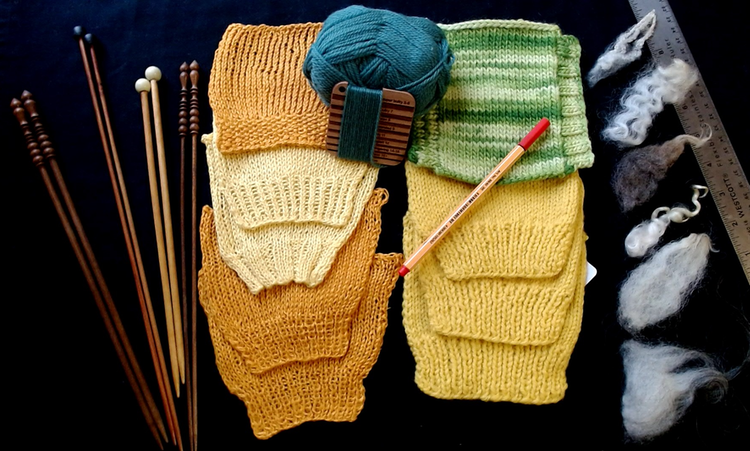
Fiber to Fabric for Knitters: How the underlying fiber informs the knitted fabric with Margaret Radcliffe
From dependable sheep’s wool to tricky rayon, every yarn is individual. Each type of fiber, from a specific breed of sheep or other fiber-bearing animal, from plants like bamboo, hemp and flax, manmade or remanufactured, brings its own distinct benefits and challenges to a knitting project. Learn to evaluate the potentials of your particular yarn and approaches that ensure success in your hand knit garments. We will cover the roles of garment architecture, fit and borders, ways to prevent sagging and biasing in inelastic fibers, and pattern stitches and seaming to stabilize garments. Class will be a combination of lecture, hands-on work, and discussion. Students will take away an understanding of fiber characteristics, yarn behavior in knitted fabrics, and an arsenal of techniques for best results. Note that homework will be assigned to be completed before each of the four class sessions.
This class is presented in collaboration with John C. Campbell Folk School and Lessonface. Class capacity is 20 students. Students are invited to attend a large group Orientation and Closing Ceremony to connect with various classes online.
Class Materials
Additional documentation about materials and class work will be provided once registered participants access the private class page.
• One ball of each of the following yarns. Sport, DK or worsted weight preferred.
1. 100% fine wool (for example, Merino)
2. 100% longwool or coarser wool (for example, Icelandic, or Wensleydale)
3. 100% other animal fiber (for example, angora, alpaca, or cashmere)
4. 100% cotton
5. 100% linen or hemp (be sure to get natural which is stiff, not rayon)
6. 100% silk or rayon (look for a soft slippery yarn, rather than one that’s been processed and spun to feel like cotton. Fine yarns intended for weaving can be used doubled or tripled for knitting.)
• A small amount of stretchy fingering weight wool yarn (for example sock yarn)
• Needles in the sizes used to knit homework, plus needles 2 and 4 sizes smaller and 2 sizes larger.
• Ruler (12”-18” long)
• Calculator
• Optional: Wraps per inch (wpi) tool. You can also use your ruler, a narrow piece of cardboard, a short dowel, or a pencil marked with a 1” or 2” length using permanent marker.
• Optional: Tags for labeling swatches
• If you have one, a notably successful or a notably unsuccessful garment knit in yarn from a single fiber (i.e. 100% wool, cotton, silk, angora, linen, rayon, etc.). Forward a clear photo of the garment to instructor
• Basic knitting supplies (scissors, markers, cable needle, etc.).
Age Range
Teens and Adults
Skill Level
Intermediate
Contact the Teacher
Send a direct message from the teacher's profile page with any questions you might have about the class.
About the John C. Campbell Folk School & Lessonface
Since 1925, the John C. Campbell Folk School in Brasstown, North Carolina has transformed lives, and brought people together in a nurturing environment for experiences in learning and community life that spark self-discovery. Since 2012, Lessonface has connected more than 30,000 students with over 2,500 great teachers for live music, language, and arts lessons online, delivering on our mission to help students achieve their goals while treating teachers equitably.


When
The class will meet for four weekly 120-min live online sessions on Thursdays at 7 pm ET | 4 pm PT on the schedule below. The first session is on January 11.
Enrolled students receive 30-day access to the video recordings of the classes.
How It Works
Enroll above to save your spot in the class. Lessonface will send you a confirmation right away, and a Zoom link 24 hours before the class start time. You can log into your Lessonface dashboard to access class materials, communicate with your instructor, join the live Zoom session, and access the class recordings and chat transcript afterward.
Refund Policy: To cancel an enrollment or request a refund, contact [email protected]. For 30+ days before, we refund 95%. Between 30 and 5 days, receive a 75% refund. No refunds within 5 days of class start date. Materials kit fees are non-refundable.

Margaret Radcliffe
Margaret Radcliffe is the author of the Knitting Answer Book, The Essential Guide to Color Knitting Techniques, Circular Knitting Workshop, and The Knowledgeable Knitter. She has worked professionally as a knitting teacher since 1991 and as a designer since 1997.