
The Key of A for Piano: A Major Scale & Chords
The key of A major is a bright, resonant key that's widely used across classical, pop, rock, and country music. With three sharps (F#, C#, and G#), it strikes an excellent balance between brilliance and playability. In this article, we'll explore what makes the key of A unique, how to play it on piano, and why it's an essential key for pianists to master.
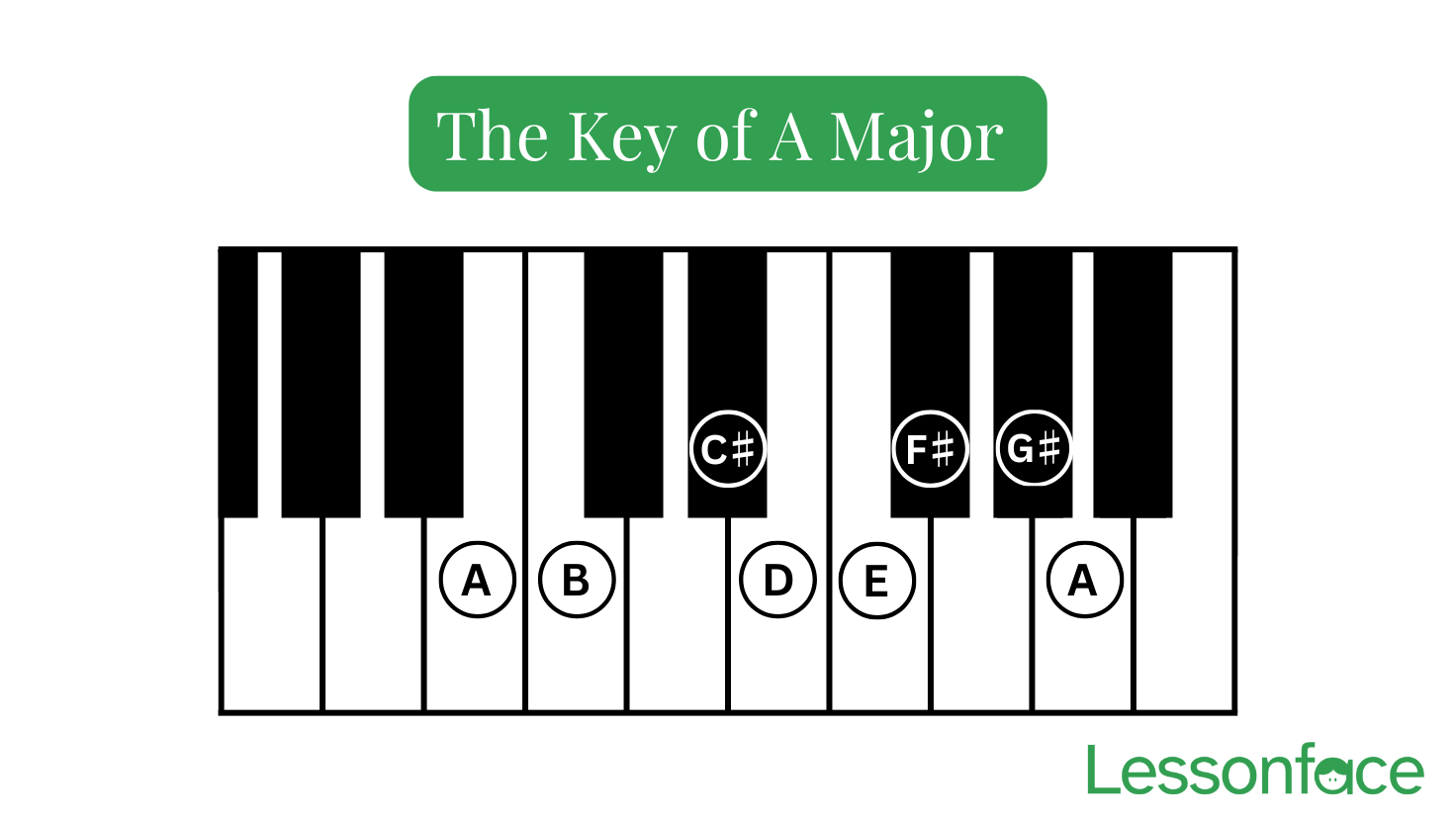
What Is the Key of A Major?
The key of A major is built around the A major scale, which consists of seven notes:
A - B - C# - D - E - F# - G# - (A)
This scale includes three sharps: F#, C#, and G#, which are essential to maintaining the proper whole step and half step pattern that defines a major scale. The presence of these sharps gives the key a particularly bright and shimmering quality.
Like all major scales, the A major scale follows a specific sequence of whole steps (W) and half steps (H):
- 1 (W) 2 (W) 3 (H) 4 (W) 5 (W) 6 (W) 7 (H) 8
To apply this pattern to the key of A, you need to follow the rules for correct "spelling" of the major scale in order to name the black keys correctly. For example, even though they are played with the same black key, G# is not the same as Ab. The names are not interchangeable, and using the wrong one would cause confusion. Here are the rules to writing a major scale correctly:
- Use every letter of the musical alphabet once and only once. Do not skip or repeat any letters.
- Do not mix sharps and flats in a single major scale.
Apply these rules to the major scale formula, starting on the note A, and you have the A major scale:
- A (W) B (W) C# (H) D (W) E (W) F# (W) G# (H) A
When you're playing in the key of A major, the key signature at the beginning of the piece will have sharp signs on the lines for F and C, and the space for G. Whenever you encounter an F, C, or G in the key of A, you'll play F#, C#, and G# instead, unless specifically marked with a natural sign (♮).
If you're interested in deepening your understanding of scales and music theory, explore online lessons in music theory here.

How to Play the A Major Scale on Piano
To play the A major scale, you'll need to use both white and black keys. Here's the proper fingering:
- Right Hand: 1 (A) - 2 (B) - 3 (C#) - Thumb under - 1 (D) - 2 (E) - 3 (F#) - 4 (G#) - 5 (A)
- Left Hand: 5 (A) - 4 (B) - 3 (C#) - 2 (D) - 1 (E) - 3 (F#) - 2 (G#) - 1 (A)
Practice slowly at first, ensuring clean transitions between white and black keys. Pay special attention to the crossover points where you pass your thumb under (right hand) or cross over your thumb (left hand). When you play in the key of A major, warming up with an A major scale will help get your ear in tune and your fingers ready to play the sharps.
If you need help with proper technique, try a free 15-minute trial lesson with one of Lessonface's excellent online piano teachers.
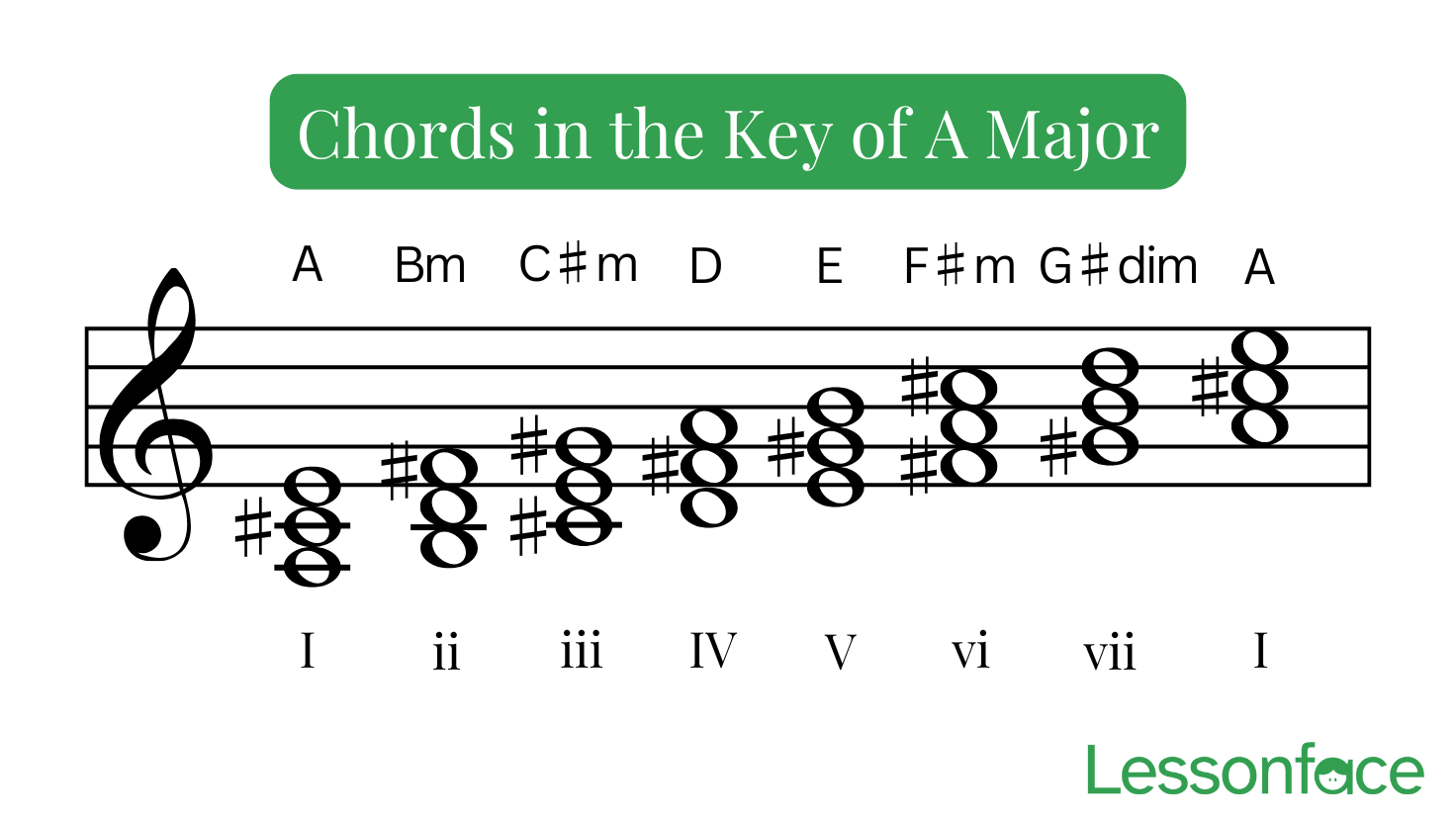
Chords in the Key of A Major
The key of A major contains seven diatonic chords, built on each note of the scale:
- A major (A - C# - E)
- B minor (B - D - F#)
- C# minor (C# - E - G#)
- D major (D - F# - A)
- E major (E - G# - B)
- F# minor (F# - A - C#)
- G# diminished (G# - B - D)
The primary chords in A major are:
- I - A major
- IV - D major
- V - E major
These three chords form the foundation for countless songs in the key of A major. Many pop and rock songs use these chords extensively, often in variations of the I-IV-V progression.
Why Learn the Key of A Major?
- Popular in Many Genres: A major is frequently used in rock, pop, country, folk, and classical music due to its bright, clear sound.
- Guitar-Friendly: The key of A major is one of the most comfortable keys for guitarists, making it excellent for piano-guitar collaborations.
- Vocal Sweet Spot: A major often sits in a comfortable range for many vocalists, explaining its popularity in songs with prominent vocal melodies.
- Technical Development: With three sharps, the key offers excellent practice for navigating between black and white keys, building finger independence and dexterity.
Popular Songs in the Key of A Major
Classical Piano Repertoire in A Major
Beginner classical piano pieces
For pianists just starting to explore classical repertoire in A major, these pieces offer an excellent introduction. They help develop comfort with the three sharps while maintaining manageable technical demands:
- Clementi's Sonatina in A Major, Op. 36 No. 2 (First Movement) - An accessible introduction to classical form with clear phrases and moderate technical demands, perfect for developing comfort with the key of A major.
- Bach's Prelude in A Major (from the Well-Tempered Clavier, Book 1) - Though Bach's preludes can be complex musically, this particular prelude features a straightforward texture with broken chords throughout.
- Tchaikovsky's "Morning Prayer" from Album for the Young, Op. 39 - A gentle piece in A major that helps develop lyrical playing while maintaining manageable technical demands.
- Kabalevsky's "A Little Joke," Op. 39 No. 13 - A playful piece in A major that features staccato articulation and helps develop coordination between the hands.
- For expert guidance as you take your first steps, try online piano lessons with one of Lessonface's excellent piano teachers.
Intermediate classical piano pieces
These pieces build upon basic skills while introducing more complex musical and technical challenges:
- Mozart's Piano Sonata No. 11 in A Major, K. 331 (First Movement) - The theme and variations form of this movement provides an accessible entry point to Mozart's sonatas, with each variation offering different technical challenges.
- Chopin's Prelude in A Major, Op. 28 No. 7 - A brief but beautiful mazurka-like piece that develops sensitivity to rhythm and phrasing.
- Beethoven's Für Elise (the middle section in A major) - While most know this piece for its famous A minor theme, the contrasting A major section provides excellent practice in the key.
- Schubert's Waltz in A Major, Op. 9 No. 2 - A charming piece that helps develop balance between melody and accompaniment, with elegant phrasing.
- Explore more pieces like these in online lessons with one of Lessonface's classical piano teachers.
Advanced classical piano pieces
For pianists ready to tackle substantial works in A major:
- Mozart's Piano Concerto No. 23 in A Major, K. 488 - One of Mozart's most beloved piano concertos, known for its expressive slow movement and spirited finale.
- Beethoven's Piano Sonata No. 2 in A Major, Op. 2 No. 2 - An early but sophisticated sonata that requires technical fluency and stylistic understanding.
- Haydn's Piano Sonata in A Major, Hob. XVI:26 - A classical sonata featuring elegant melodies and demanding technical passages, perfect for developing stylistic awareness.
- Chopin's Polonaise in A Major, Op. 40 No. 1 ("Military") - A grand, heroic piece that requires technical command and expressive breadth.
Popular Music in A Major
Pop Songs
Throughout pop music history, A major has been favored for its bright sound, which enhances vocal melodies while being easy to play on both piano and guitar.
- Ed Sheeran's "The A Team" – This acoustic ballad is set in A major, featuring intricate guitar work.
- Adele's "Someone Like You" – A heartfelt piano-driven song composed in A major.
- ABBA's "Dancing Queen" – A timeless pop anthem set in A major, featuring catchy hooks and melodies.
- Ben E. King's "Stand By Me" – A soul classic in A major with a simple, enduring chord progression.
- Beyoncé's "Halo" – A soaring vocal performance supported by the uplifting quality of A major.
- Sarah McLachlan's "I Will Remember You" – A reflective, melodic pop ballad composed in A major.
- Explore more pieces like these in online lessons with one of Lessonface's pop piano teachers.
Rock Songs
Rock musicians have often turned to A major for its powerful sound on both electric guitars and keyboard instruments.
- Eric Clapton's "Tears in Heaven" – A poignant ballad composed in A major, featuring soulful guitar work.
- The Beatles' "Here Comes the Sun" – A joyful, acoustic-driven tune set in A major.
- Ramones' "Blitzkrieg Bop" – A punk anthem in A major that captures high-energy simplicity.
- Pink's "Just Like a Pill" – A pop-rock hit rooted in A major, combining emotional lyrics with driving rhythm.
- Bob Marley's "Three Little Birds" – A reggae classic in A major with a relaxed, optimistic tone.
- Explore more pieces like these in online lessons in rock piano.
Tips for Mastering the Key of A Major
- Scale Practice: Practice the A major scale daily, focusing on proper fingering and smooth transitions between black and white keys.
- Sharp Awareness: Make sure to consistently play F#, C#, and G# rather than their natural counterparts.
- Chord Progressions: Work on common progressions in A major, such as:
- A - E - F#m - D
- A - D - E - A
- A - F#m - D - E
- Ear Training: Learn to recognize the sound of A major and its characteristic bright quality.
- Arpeggios: Practice A major arpeggios to reinforce chord shapes and finger patterns specific to this key.
Common Challenges and Solutions
- Remembering the Three Sharps
- Create memory aids: "Fat Cats Go" (F# C# G#) to help you remember the order of sharps in the key signature.
- Practice the A major scale slowly, focusing on accuracy until the sharps become automatic.
- Black Key Navigation
- Position your hand slightly forward on the keyboard to make reaching the black keys more comfortable.
- Practice "black key groups" to build familiarity with their positions (C#-F#-G# in A major).
- Thumb Crossings
- Isolate and practice the thumb crossings slowly, focusing on smooth transitions.
- Use slight wrist rotation to facilitate the thumb passing under (right hand) or fingers crossing over (left hand).
- Practice hands separately before combining them.
Conclusion
The key of A major offers a perfect combination of brightness, versatility, and technical interest for piano players. Its three sharps provide enough challenge to develop key awareness and finger dexterity, while its widespread use across musical genres provides a wealth of repertoire to explore. Whether you're playing classical sonatas, pop ballads, or rock anthems, understanding A major will significantly expand your musical capabilities.
Regular practice of scales, arpeggios, chords, and pieces in A major will help you develop confidence with this key. Remember to start slowly, focus on accuracy, and gradually build up speed as your comfort level increases.
Ready to deepen your understanding of A major and expand your piano skills? Connect with one of the wonderful piano teachers who are currently accepting new students online through Lessonface. These experienced instructors can guide you through the technical challenges of playing in different keys while helping you build a strong foundation in piano technique.
For those who prefer to learn at their own pace, explore Lessonface's self-paced courses in piano. You can also enhance your overall musicianship with courses focused on music theory, reading music notation, and good practice habits here. These fundamental skills will help you master not just A major, but all keys and aspects of piano playing.
The Lessonface platform makes quality music education accessible to everyone, from beginners taking their first steps into piano playing to advanced musicians refining their interpretations of complex repertoire. Through virtual lessons, you can learn from skilled instructors who understand how to adapt their teaching methods to your unique needs and goals. The platform's flexible scheduling and diverse teaching approaches ensure that you can find the perfect match for your learning style and musical aspirations, all while enjoying the convenience of learning from home.
Related articles exploring the scales and keys on piano:

Start Lessons
Search for your perfect music, language, or arts teacher and start working towards your learning goals.

Start with a Free Trial
Teachers on Lessonface set their own rates and discounts. Participating teachers offer free trials.
Great Teachers, Great Lessons, Guaranteed
Learn more about the greatest universe for online music and arts lessons.

Lessonface Recitals, Open Mics, Masterclasses, and Jams
Welcome students of all ages and skill levels!